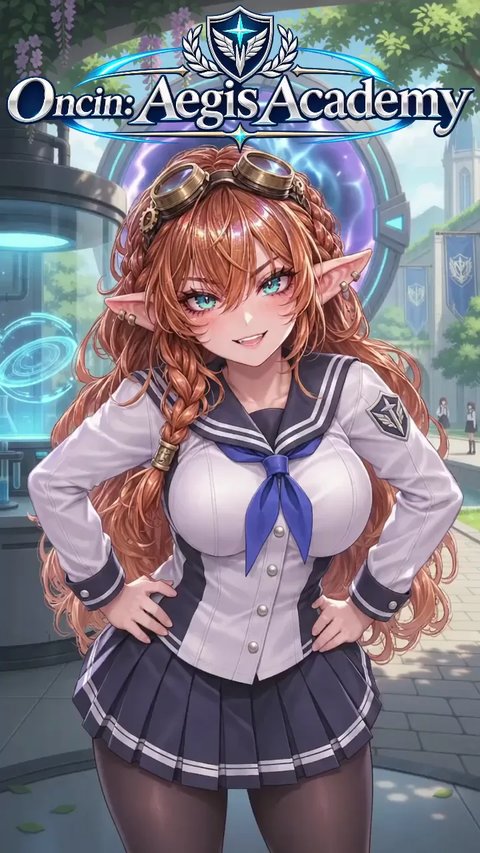
Introducing Aegis Academy: My First Original ONCIN World
Oncin ·
Introducing Aegis Academy
Hey everyone. I’ve been working on this world for quite a while, and I think it’s finally time to properly introduce it.
Aegis Academy is my first fully original ONCIN world with its own original setting, story, history, characters, and lore.
Until now, most of my worlds have been built around existing universes. Aegis is different.
This time, I wanted to build the entire world myself.
The history.
The supernatural system.
The academy.
The societies and civilizations.
The characters.
The conflicts.
The wider multiverse.
And the story developing underneath all of it.
Aegis Academy is a supernatural academy life simulator set on Earth in 2042, in a world where humanity has already discovered other dimensions, other civilizations, supernatural energy, and the existence of a much larger multiverse.
You begin as a student.
You attend classes, train your abilities, experiment with supernatural disciplines, choose what kind of specialist you want to become, meet people, build relationships, explore the world, and gradually decide what kind of life you actually want to live.
But while making Aegis, I also wanted to push ONCIN much further as a simulation.
I wanted the world to feel like somewhere you actually live, rather than somewhere the narrator simply tells you about.
And two of the systems I’m most excited about came from that idea.
A Working In-Universe Internet
Aegis Academy has an actual in-universe Internet.
Not just a lore menu.
Not just a button that secretly asks the narrator to explain something.
You can open your terminal and actually search for information from inside the world.
You can research supernatural phenomena.
Look up Universal Energy.
Search organizations.
Learn about other dimensions and civilizations.
Find academy information.
Look up public information about people.
Read articles.
Browse student discussions.
Check public records.
And even see social media and public reactions to things happening in the world.
If something major happens, the Internet can reflect how people are reacting to it.
You might see people arguing about an event.
Students discussing rumors.
Public reactions to supernatural incidents.
Different opinions about organizations, governments, discoveries, or conflicts.
Something that happens during your campaign doesn’t necessarily remain trapped inside the main narrative.
If it becomes publicly known, it can become part of the information environment around you.
The Internet is also supposed to respect what people in the setting could actually know.
If something is classified, private, undiscovered, hidden, or simply hasn’t happened in your campaign, the Internet shouldn’t magically reveal it.
And because campaign history can diverge, the Internet isn’t meant to behave like a frozen encyclopedia either.
The world changes.
Public knowledge changes with it.
So instead of constantly asking:
"Narrator, what is this?"
sometimes you can do exactly what someone living in 2042 would do.
Search it.
A Working Contacts and Messaging System
Then there are Contacts.
This isn’t just a character menu.
You can actually message characters directly from inside the world.
One-on-one conversations happen through the terminal just like actual private messaging.
Characters can be online or offline.
They can reply later.
They can read something without replying.
You can continue conversations outside face-to-face story scenes.
And there are group chats too.
Your group of friends can actually talk together instead of every conversation needing to become a narrated scene.
But the important part is that Contacts is not separate from the campaign.
What happens in chat actually happened.
If you tell someone something through Contacts, they now know it.
If someone tells you something, your character learned it.
If you argue with someone through messages, that can affect the next time you meet.
If you make plans with somebody, those plans can carry directly into the story.
If you message:
"Meet me at the station tomorrow at 7."
and they agree, that is now something the campaign can actually remember and follow through on.
The messaging system also exists inside the same timeline as the story.
If you spend ten minutes talking to someone, ten minutes passed.
If you spend half an hour chatting late at night, that half hour is part of your evening.
The rest of the universe doesn’t politely freeze because you opened your Contacts.
That small connection between messaging and campaign time was something I really wanted because it makes the system feel less like an external chatbot and more like part of the world itself.
You aren’t opening an out-of-character AI window attached to an NPC.
You’re texting someone who exists inside your campaign.
Characters Aren’t Just Waiting for You
Another major focus for Aegis is character agency.
Characters aren’t supposed to exist only for the protagonist.