 Yumina
Blog
What AI Actually Changes About Game Design
Games and human nature, with AI revolutionizing everything
Satisfaction is not what you think it is
As a game creator, there are two most important things 1. reduce pain points. 2. elevate the satisfaction of high points. But most people have a huge misunderstanding of how attention and satisfaction actually work.
Your instinct might tell you that the satisfaction in a MOBA comes from getting kills. But there are plenty of support players, utility mids, and people playing low-resource roles who still absolutely love these games. Why?
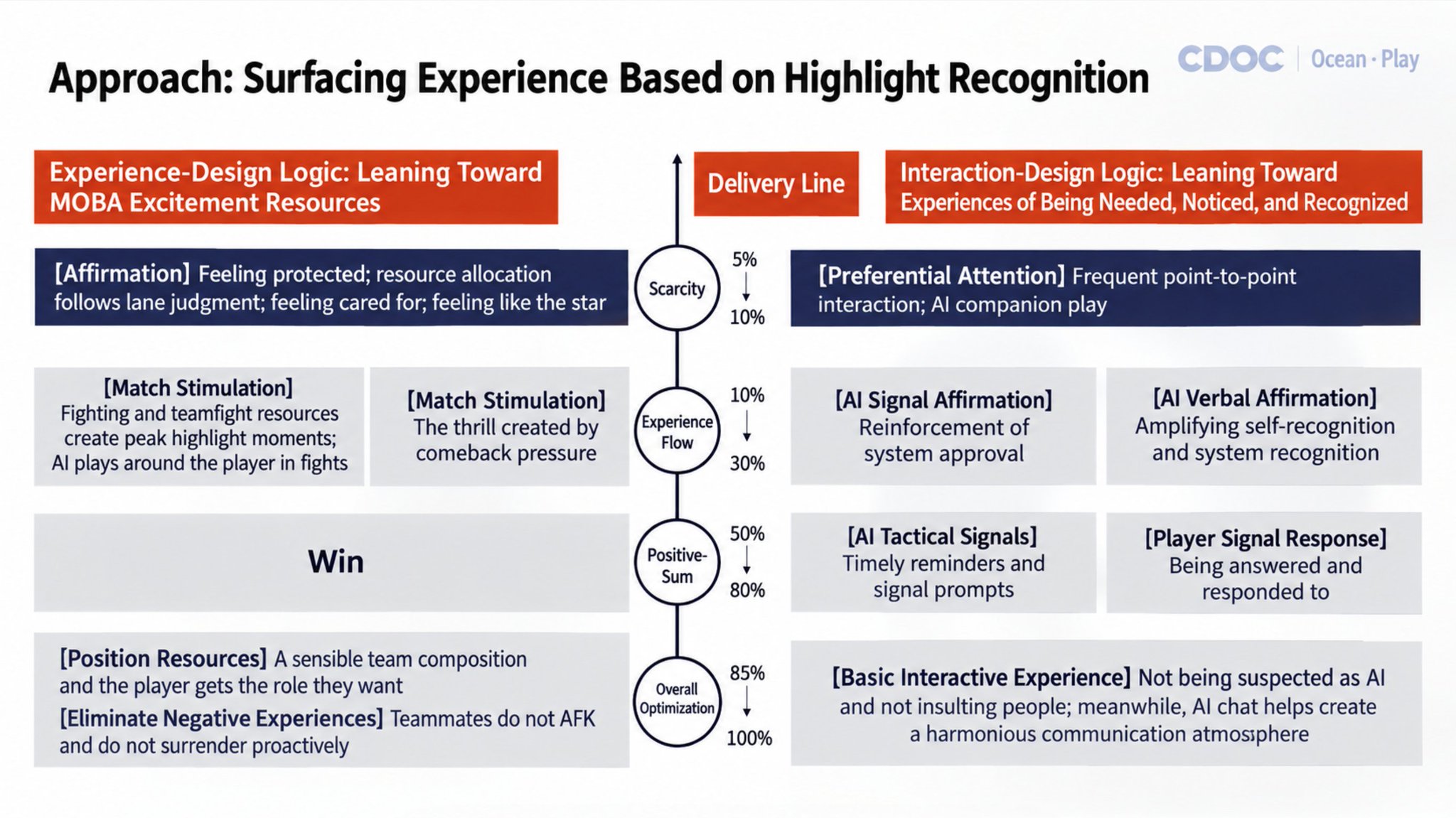
Because the core of a MOBA was never really about getting kills. It is about satisfying people's desire for intense competition, and more importantly, making them FEEL NEEDED within their role. This is why many MOBA games like Honor of Kings increasingly use AI and bots to manufacture certain experiences for players. You might get crushed in the early game, then make an exciting comeback later. Bot teammates might like you after the match, or even invite you to play another game. This is because they figured out that people value such experience much more than simply winning.
You only remember two moments
Now, if you think carefully about the last time you played a game, you might realize that you only remember one or two of the most important moments. This is basically the peak-end effect of attention. People tend to remember the most frustrating moment, the most satisfying moment, and how the experience ended. And very often, your last match is usually one of the best matches you played that day (stats show that people who lost tend to play one more game just to reach a happy ending).
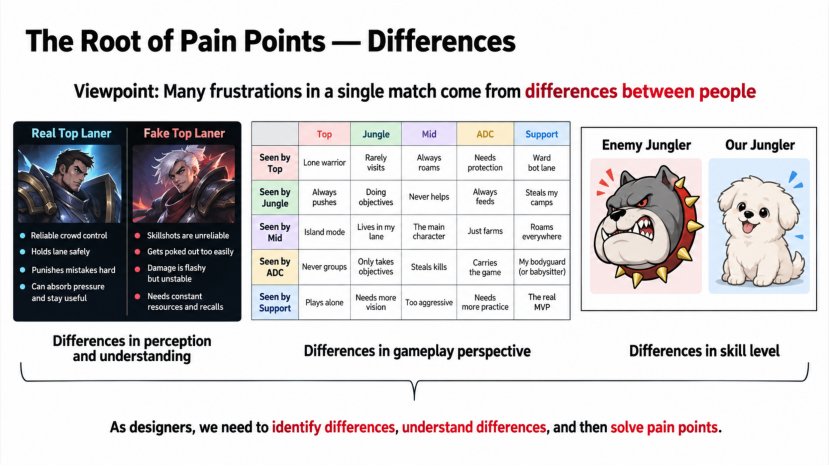
Reducing the lows of this effect is what we call solving pain points. But solving pain points is extremely difficult, because every player has different expectations, plays from a different perspective, and experiences the game differently. On top of that, what players believe the pain point is may not even be the real problem. ELO systems are a good example.
Amplify the highs, disguise the lows
Because of this, instead of only thinking about how to eliminate pain points, games should pay much more attention to amplifying the highs.
And pain points do not necessarily have to be completely solved. Sometimes they can simply be disguised. For example, in an FPS, when you die, you might immediately pull out your phone and scroll TikTok because there is literally nothing you can do. TFT solved this problem in a very clever way.
In TFT, unless you are in the late game fighting someone at a very similar strength and need to think about positioning for the next round, you probably should not spend much time if at all staring at the board during combat.
But one of the most satisfying parts of the game is literally watching your pieces fight. That kind of passive viewing, where you do not have to stay mentally tense, fits the nature of people's inability to multitask. It makes players feel occupied and creates an illusion that they're valuable, even though they can't do shit during that period.
Another way to disguise frustration is to make people believe that next time, they will succeed.
This is basically the core principle behind gambling. FPS games are very good at making players think, "I was so close. Next time I'll definitely hit his head." This helps explain why FPS games have created such a massive gaming peripherals market.
People convince themselves that the reason they missed was because their monitor was not a 600hz ZOWIE or their keyboard was not a Wooting. They believe with a little more practice and slightly better equipment, next time they will hit the shot. Games like this are extremely good at hiding their core emotional loop, and good games in general tend to do the same thing.
In the long run, they are fundamentally skill-based. But in the short run, they introduce enough luck to preserve the player's confidence and reduce the frustration of new players (which RTS is terrible at). Poker works the same way. You can be terrible at poker and still get a cooler. You can be terrible at an auto battler and still randomly hit the perfect high-roll game. In an FPS, you can be terrible and still have random spread put a bullet into someone's head.
No matter how complicated a game becomes, there is usually a very simple positive feedback loop underneath it... MMOs are built around human connection... Extraction games are built around greed, risk, and the feeling of escaping with something you probably should have lost. All of these systems are ultimately satisfying something people feel they are missing.
Hide the human nature, show the gameplay
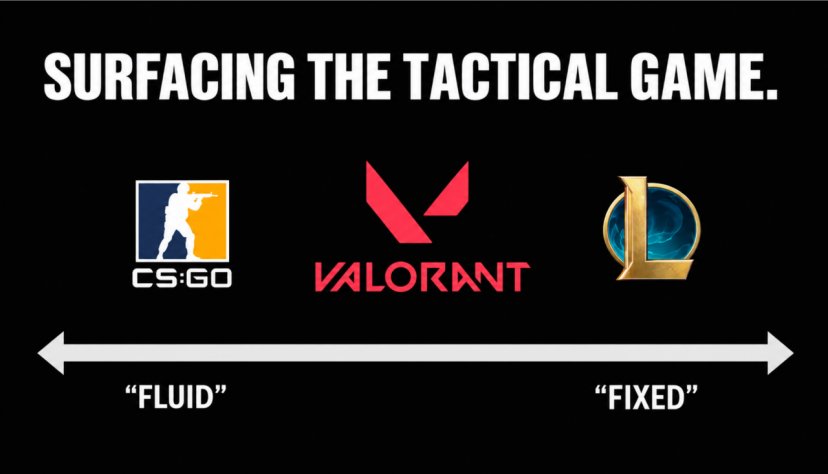
One important thing is that a game's satisfaction of human nature should usually remain hidden, while the gameplay itself should be clearly communicated to the player.
Valorant is a good example. Its designers use very explicit Agent abilities to communicate that this is a tactical game, instead of burying the tactical layer behind utilities like Counter-Strike.
What AI actually changes
Going back, just like bots can satisfy human needs inside a MOBA, AI itself is a tool that can understand players and generate personalized content.
Because of this, I believe the future of entertainment will still be created by people who understand human nature. The difference is that tokens will allow a book, a movie, or a game to adapt itself to the taste of every individual player and become interactive.
AI has enormous potential across the entire entertainment industry. Allowing AI to become the core game play itself rather than just a tool to create a game. It can make player decisions actually affect the story. It can control diplomacy, random events, economic systems, weather systems, and almost every other variable inside a game.
That is the bet behind Yumina: a world engine where the AI runs the world's state and events, and the person who built the world sets the rules it has to play within.
RTS as the example
Here, I want to focus specifically on RTS games as an example.
RTS is basically the ancestor of tower defense, MOBAs, strategy games, and many other genres. It created countless incredible branches. But RTS itself slowly declined because it carries some enormous pain points. Losing feels terrible because you only get to blame yourself - making you feel stupid. And a lot of losing moves are just small decisions or a brief loss of attention as most players cannot handle managing multiple fronts.
The games are mentally exhausting.
With AI, a lot of this will change.
1. AI can elevate satisfaction
The most important RTS satisfaction loop is that it lets the player feel intelligent. It is the same feeling that made them feel that they're superior to all other players.
You are the commander.
You control multiple armies. You make decisions early and hope those decisions create a payoff at some point in the near future. You enjoy the feeling that everything happening on the battlefield exists because of decisions you made.
So when designing an RTS, the game should constantly make players feel smart. Players should feel like the good decisions came from them, while bad outcomes either have something else they can reasonably blame, or make them believe that next time they will make the right decision.
Today, AI can already read the state of a game engine and dynamically generate events around the player's actions. Imagine Player A hides soldiers inside a forest early in the game. Even if Player B never actually walks into the trap, the AI can still give Player A some kind of positive feedback for making that decision. Maybe it triggers a small mysterious event that does not meaningfully affect balance. Maybe it plays a short cinematic showing that one of the enemy scouts was captured. The player's decision still feels meaningful, even if the exact trap never happens.
2. AI can create far more variation and control far more variables
Diplomacy in games like Civilization and Stellaris no longer needs to rely on massive amounts of prewritten dialogue. Relationships can change dynamically based on the state of the war and the player's actual behavior. You could personally negotiate with another alliance. You could respond to diplomatic incidents. You could handle reputation events in your own way.
This creates a much more personalized experience while also reducing the amount of content designers need to manually produce.
3. AI can fundamentally change how command-based games handle control and multitasking
You no longer need to manually control every single unit and experience the frustration of losing the entire game because your attention was stuck on one small fight.
Instead, maybe you write a few letters to your generals, tell them what you want, and let them carry out the work while you focus on the part of the battlefield you actually care about. This could include AI-controlled pathing, movement, and tactics.
You could also define the behavior and priorities of different unit types in advance, then let the AI decide which behavior to execute based on the player's actual commands and inputs. That may also help solve some of the balance problems introduced by AI, because the AI is not simply inventing actions without limits. It is choosing between behaviors the designer has already defined.
(This is how worlds on Yumina work in practice: the creator defines the variables and rules in Studio, and the AI chooses within them instead of inventing freely.)
The smaller things: identity and spectacle
Finally, there are also a lot of smaller design details worth thinking about. Red Alert 2 managed to break outside of the traditional RTS audience even though it was neither the most competitive RTS nor the most mechanically demanding one.
A huge part of that came from how much it cared about entertainment. From a pure balance perspective, you could argue that only Iraq and France, were truly competitive. But EA still made every country feel extremely distinctive. The US paratrooper, the Libya demolition truck, the Cuban terrorist... You usually cannot engineer a game into becoming a cultural phenomenon. But thinking about entertainment value and identity from the very beginning can maximize the chance that it happens.
And that identity does not even have to come from gameplay itself. It could come from a ridiculous art style, funny animations, or something else people immediately remember. Red Alert was also extremely visual and understood spectacle.
Masses of tanks rolling across the battlefield, Kirovs reporting, nuclear missiles going off. These things satisfy a very simple fantasy of overwhelming destruction and power.
Three questions before you ship
So next time, instead of just rushing on X to share an AI-slop game demo, maybe consider these things too.
- What is your game's underlying feedback loop? What feelings do you want it to bring?
- Do we really need this UI/game theme here? Does this reinforce our core emotional feeling?
- Does this UI/game flow convey the most information with simplicity and follow user expectations? This includes you thinking behind the color, size of buttons, or even lighting inside the game.
These questions matter far more than simply creating a "cool" game demo.