 Yumina
AI Entertainment Apps That Stay Closed Will Die
Every AI roleplay app and AI game platform today profits from the gap between what a model costs and what they charge for it. Here is what that gap does.
AI entertainment apps that do not open source will die.
Not because open source is nicer. Because of how they make money. Every AI roleplay app and AI game platform today runs the same business: buy tokens from a model provider, sell them to players at a markup. The company is the gap between the model's cost and the model's price. That gap does four things to the product, and then it does one thing to the company.
I build one of these. Yumina is an open-source engine for AI roleplay and AI games, and the first decision we made was to make nothing on tokens, which is where the money is. This is why.
1. Context memory gets cut, and the AI forgets
A model remembers nothing between messages. Every turn, the app re-sends the whole conversation up to its memory limit and pays for every token again. Fifty turns of 300 tokens is 15,000 tokens of story; the app has billed 382,500 input tokens to carry it. For a company living on the markup, memory is the biggest cost and the easiest cut. Cut 32K to 8K and a long chat costs a quarter as much. No player sees a line item change.
That is the number they hide. October 2026:
| Platform | Memory you get | Price |
|---|---|---|
| AI Dungeon | 4K free, 8K, 16K, 32K by tier (2K free on some models) | $14.99 to $99.99 |
| Janitor AI | 8,000 to 9,000 tokens free; "5x" on Janitor+ | free; $12.99 |
| SpicyChat | 4K free, 8K, 16K; 32K on eight models | $5.95 to $29.95 |
| CrushOn AI | 8K free, 16K paid, 24K on "Ultra" models | $5.99 to $199.99 |
| Chub AI | 8K cheap tier, 60K on Mars | $5; $20 |
| Yodayo / Moescape | 32K and 64K on selected models | $9.99 to $39.99 |
| Isekai Zero | about 10K free, "131,000+" premium | pay per message |
| Friends & Fables | 4,000 to 13,500 characters, not tokens | free to $39.95 |
| Kindroid | about 18,000 characters short-term | $13.99 and up |
| Character.AI | never published; sells "4x the Memory" as a paid style | free; $9.99 |
| Chai, Replika, Nomi, Talkie, Candy, Linky, PolyBuzz, OOC, Sekai, Status, Voyage | not published | various |
Sources: AI Dungeon, Janitor, Chub, Isekai Zero, Friends & Fables, Kindroid, Character.AI. SpicyChat and CrushOn figures are from their plan pages and the reviewers who track them.
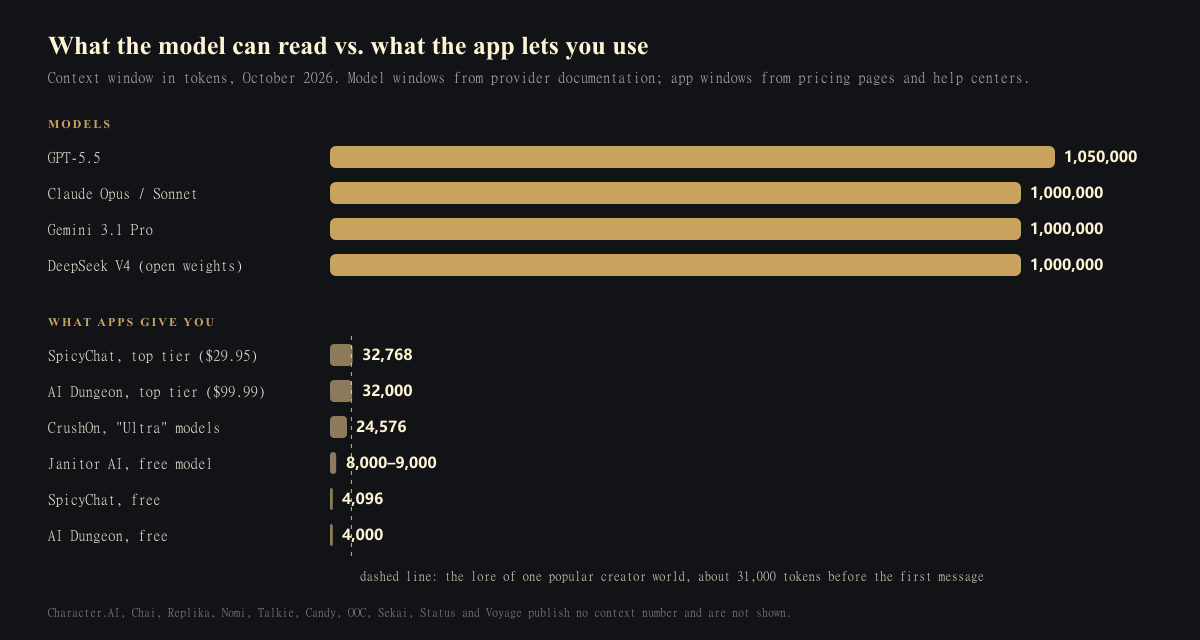
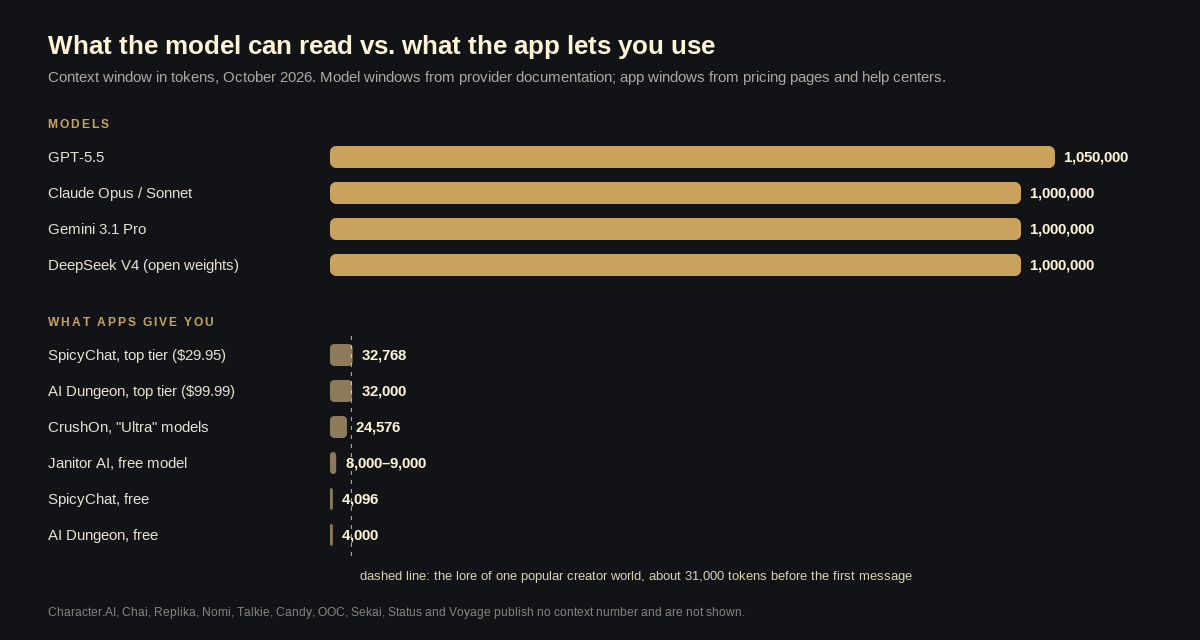
The models underneath read a million tokens: Claude, Gemini 3.1 Pro, GPT-5.5, DeepSeek V4. The apps give you 0.4 to 3 percent of that, and twelve of the twenty-one will not say which.
Eight thousand tokens is about twenty exchanges. The things a player cares about, the promise made early, the name of the character's brother, the running joke, are exactly the things they expect the AI to keep. When the character has no idea thirty turns later, the player loses more than the moment. They lose the belief that any of it was real. Bad pacing or a weak plot can be forgiven. Forgetting cannot, because the player is the one who remembers.
Nomi's May 2026 update cut memory to the last ten or twenty messages; annual subscribers cancelled. Chai's paying users hit unannounced token limits in February 2026. Everweave capped its dungeon master at 300 words in July and its reviews filled with "cash grab". None of them wanted a worse product. They had a token bill.
We had the same bill and went the other way. Yumina's free plan runs at 64,000 tokens of memory with no key and no payment, on a model that costs nothing to use: as much as the most expensive paid tier in the table, more than the rest. Bring your own API key and there is no cap from us at all; the limit is the model's own window. We are not reselling those tokens, so there is nothing to ration.
2. A few thousand tokens fits a character, not a world
A character card is a name, a personality paragraph, a scenario, a sample message. Two or three thousand tokens. That is what fits in an 8K window with room left to talk, so that is what every 8K platform is full of.
A world is different. The largest world on Yumina, Seeking the Dao, has 276 lore entries, about 280,000 tokens of writing: sects, cultivation ranks, geography, factions, named characters with histories. Pokemon: A Reborn World has 703 entries, about 200,000 tokens. The most-played world, a SEVENTEEN simulator played more than thirteen thousand times, has 40 entries and about 31,000 tokens. The engine pulls in what the current scene needs each turn, so a player never pays for all of it at once, but the author had to be allowed to write it.
On an 8K platform, none of these can exist. Not "they run worse". They cannot be written, because the platform cannot send more than a quarter of the smallest one. So nobody writes them. A catalog takes the shape of its context budget, and creators write for the free tier, where their players are, so even the people paying for 32K get content built for 8K.
One caveat. More context is not free: "Lost in the Middle" (2023) and "Context Rot" (2025) both measured models reading 200,000 tokens worse than 20,000. The answer is an engine that decides what belongs in this turn's prompt. That is a design problem. A cap is not a design. It is a budget line with a marketing name.
3. Charging per message raises the barrier to play
TikTok took in about $33 billion of advertising last year and has never charged anyone per scroll, though serving video costs real money. Instagram, YouTube, Netflix, Spotify: none of them charge by use, no matter how much you use. A meter kills the loop. The moment you think "is the next one worth it", you are not playing, you are shopping. Charging by use has never been a good business model for entertainment, and being addictive does not change that.
Tokens have a cost, and someone pays it. So the question is not whether AI entertainment should be free. It is who pays, and how many margins are stacked on top.
On a closed app, three. The provider's price, which already includes Anthropic's or Google's margin. The platform's markup, which is the business. On a phone, the app store's 30 percent; Isekai Zero publishes it, and the same credits cost about a third more on mobile. Every message is taxed three times, and the player feels every layer, because every layer shows up in the meter.
A credit counter turns the best moment of a story, the one where you want to write three paragraphs back, into a moment where you check your balance. More than a third of OOC's negative reviews are about credit cost. Isekai Zero's players call it Mana drain. Those are people deciding whether to play the next turn.
4. Markup pushes platforms to swap models and hide it
If your margin is the gap between what the model costs and what you charge, every incentive points one way. Smaller context. Cheaper model. Vaguer name. No outside keys. You do not need to be a bad person. You need a quarterly target.
Keys: of twenty-five platforms, two let you bring your own model, Janitor and Chub. If the model is the margin, your key is your margin.
Models: in October 2024, after Google paid about $2.7 billion to license its technology and hire its founders, Character.AI's interim CEO told the FT it was done training frontier models because it had become "insanely expensive". Two years later it still publishes no memory number and sells "4x the Memory" as a paid style. Nearly every in-house model in this market is unnamed: "Chai-6", "Dragonfruit", "Solstice", "the V2 engine". You cannot look them up, so you cannot tell when they change.
And swapped they are:
- December 2021: AI Dungeon pulls its GPT-3 model and puts smaller ones under the same tier names.
- February 2023: Replika switches romance off overnight, then restores it only for old accounts. Mental-health posts on its subreddit rise fivefold.
- 2023: Stanford and Berkeley measure GPT-4 falling from 84 to 51 percent on a simple task, with no announcement.
- January and April 2026: Janitor's own changelog quantizes its model, then swaps the base architecture. Users are told the style "may feel different". The subreddit fills with "JLLM got worse".
- September 2025: ChatGPT silently routes emotional messages to a stricter model until users catch it.
- October 2026: Kindroid retires three models on one day, including the free one.
Even Anthropic, which states it never degrades quality for cost, published a postmortem admitting three bugs had made Claude worse for weeks before anyone noticed. If the company that makes the model can miss that, the app reselling it will not tell you.
Now the arithmetic.
CrushOn sells 6,000 credits for $14.99, a quarter of a cent each, and lists "Ultra Claude Opus 4.7" at 24K memory. Reviewers put a Sonnet message at 24K at 42 credits, about 10.5 cents; CrushOn publishes no Opus rate, so assume the same. Anthropic's list price for Opus 4.7 is $5 per million input tokens and $25 per million output. One message with 24K of memory and a 300-token reply costs about 13 cents.
CrushOn would pay 13 cents to earn 10.5, on every Opus message, before staff, the app store, or the free tier. So one of three things is false: the memory is 24K, the model is Opus, or the price is the price. I do not know which. Neither does the customer.
Same test, any "unlimited" plan. SpicyChat's top tier is $29.95 for unlimited messages at 32K. On its real models, open-weight DeepSeek and its own finetunes, a 32K message costs it about 2 cents. On Claude Opus it would cost 13.7 cents, and $29.95 buys 218 messages.
In April 2025 CrushOn's press release promised "Claude 3.7 Sonnet and GPT-4o" with "up to 16K memory". Eighteen months later the menu says Opus 4.7 and 24K. The names climbed two generations. The memory barely moved.
5. How Yumina is built
Watching these decisions get made, one after another, is why Yumina was open source and open key from the first day, even though it means less revenue. Once a company makes money on tokens, every section above is already written for it. A company whose profit improves every time it makes the game worse does not have a bad culture. It has the wrong physics. So we do not make money on tokens.
When you spend credits, we pay the model provider for exactly that usage, on free and paid tiers alike; the paid tiers exist to cover compute, not to mark it up. There are no yearly subscriptions, because we do not know what compute will cost next year and will not sell a promise we cannot price. You can bring your own key from any provider, or run a local model on your own machine through the proxies we built, and pay us nothing to play.
The engine, the editor and the player are open source under AGPL. With your own key, memory is clamped to the model and to nothing else: a million-token model gives you a million tokens, and there is no message limit, because we are not paying for the tokens. On our own keys, the free plan gets 64,000 tokens, Gold gets 96,000, and Platinum and above get the model's full window. The code that builds the prompt is public, so anyone can read exactly what gets sent to the model and why.
And creators choose. A world can be open for anyone to download, edit and play on their own key, or it can stay closed and earn its author money through the platform's credits, the way a novel earns its author money. Expecting every creator to give their work away would be asking every author to upload their books as free PDFs. The platform makes its money on what is actually a service, hosting, payments, discovery, and not on the tokens.
It costs us the easiest margin in the industry, and we wrote that down in Yumina's vision, here and after in September and in the documentation before anyone asked. A closed app cannot follow without deleting its own business, because the markup is the company. We never built one.